


 Mar 31,2025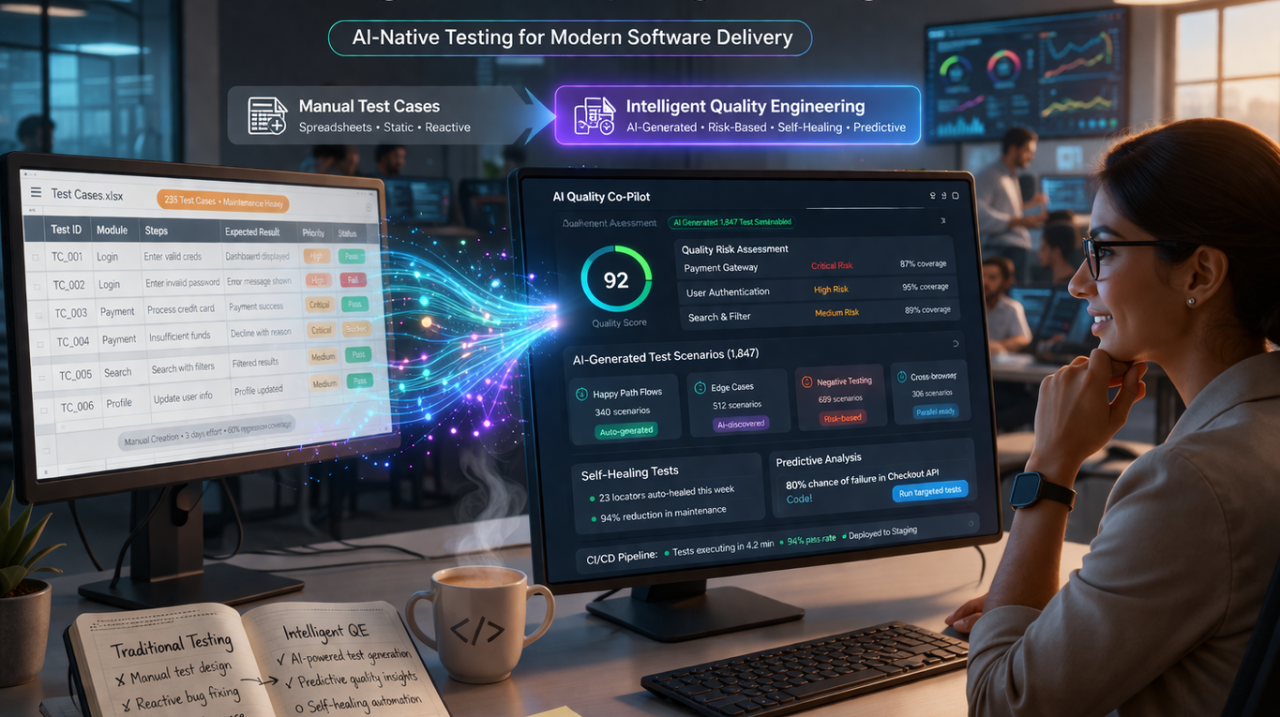
Software testing is no longer limited to writing manual test cases, building automation scripts, and reviewing execution reports after the fact. AI is pushing testing into a new era – one where quality engineering becomes more predictive, adaptive, and connected to the pace of modern software delivery.
For years, teams have struggled with the same problems: requirements change too quickly, regression packs grow too large, documentation becomes outdated, and automation coverage rarely keeps up with product complexity. Traditional testing methods still matter, but they are often not enough for teams shipping continuously. This is where AI is making a measurable difference.
AI in testing starts by reducing the effort required to turn raw inputs into usable quality assets. Requirements documents, user stories, support tickets, release notes, and business workflows can now be analyzed to generate structured test cases. Instead of starting from a blank screen, testers begin with an intelligent first draft. This does not replace human judgment – it accelerates it.
The next major shift is coverage intelligence. One of the biggest risks in software delivery is the false belief that enough testing has been done. AI can analyze requirements, existing test libraries, production incidents, and usage patterns to identify where coverage is weak. Instead of asking only, ‘How many test cases do we have?’, teams can ask, ‘What important business scenarios are not being tested well enough?’
AI also improves test maintenance, which is often the hidden cost of automation. In many teams, automated suites become fragile over time because locators change, workflows evolve, and environments behave inconsistently. AI-assisted maintenance can detect patterns in failures, suggest updates, and reduce time lost to repetitive rework.
Another growing use case is intelligent defect analysis. Not every failure is a real defect. Some are caused by environment issues, data problems, flaky automation, or downstream service instability. AI can help cluster failures, detect recurring patterns, and highlight likely root causes faster so teams spend less time sorting noise and more time addressing risk.
There is also a strategic benefit. AI turns testing from a backward-looking activity into a forward-looking one. By analyzing trends across releases – defect leakage, test execution history, feature churn, and risk concentration – AI can help engineering leaders make better release decisions and focus regression effort where it matters most.
Still, successful adoption requires balance. AI should not be treated as a magic button. Poorly written requirements, unclear acceptance criteria, and weak test strategy will not suddenly become strong because AI is introduced. The best approach is to treat AI as a quality co-pilot: let it generate, analyze, summarize, and suggest – but keep testers, developers, and product teams in the decision loop.
The future of testing will belong to teams that combine human insight with machine speed. AI is not removing the need for testers. It is elevating their role from writing repetitive artifacts to designing stronger quality strategies. The result is not less testing, but smarter testing.
Want to see how AI can accelerate test design, improve coverage, and reduce release risk? Start by identifying one repetitive testing workflow and introduce AI where it delivers the fastest value. connect with TestPlus Team which helps to achieve your quality goals