


 Mar 31,2025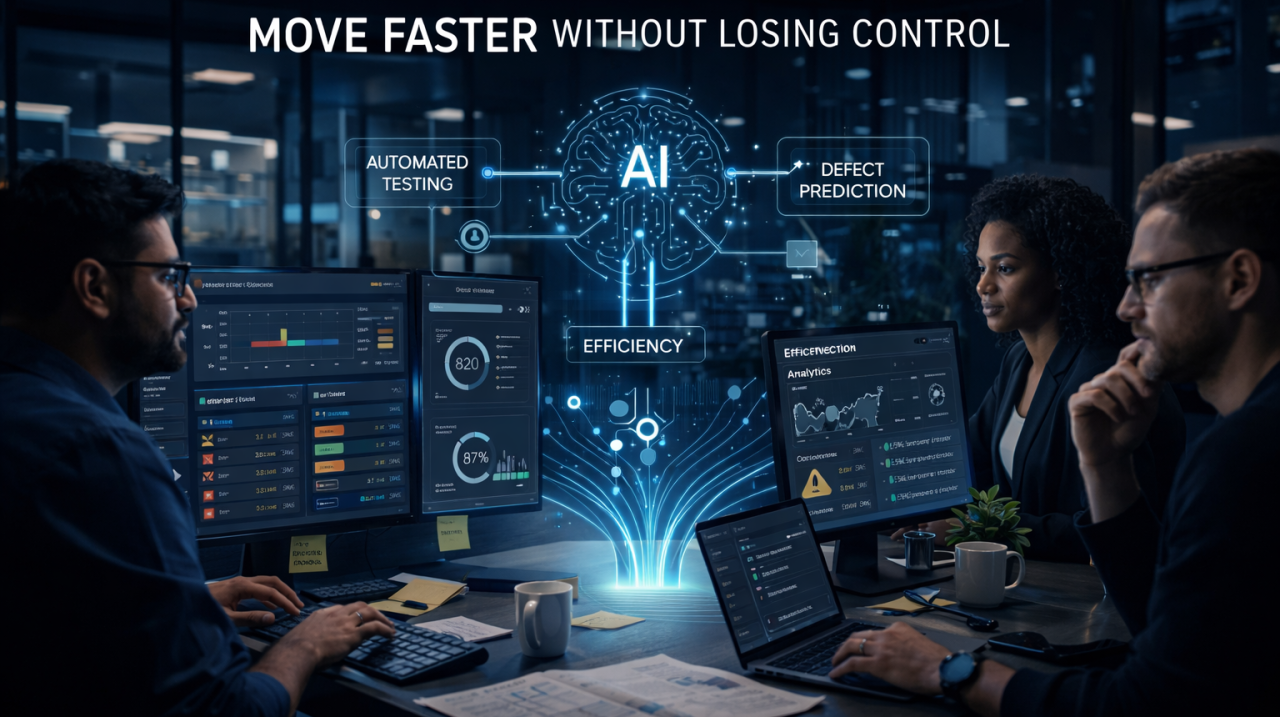
Every modern software team is under pressure to move faster. Releases are more frequent, user expectations are higher, and product roadmaps shift constantly. Yet quality teams are still expected to maintain confidence, traceability, and release stability. This tension often creates a painful trade-off: move fast and risk defects, or slow down and protect quality.
AI is helping QA teams break that trade-off. One of the most valuable benefits of AI is acceleration without removing structure. In traditional QA processes, a lot of time is spent on activities that are necessary but repetitive: converting requirements into test cases, updating old test documentation, identifying impacted regression areas, reviewing failed test runs, and responding to stakeholder questions about quality status.
AI reduces that burden by acting as an operational layer across the QA lifecycle. When a user story is created, AI can help generate candidate test scenarios. When a release is prepared, AI can suggest impacted areas based on feature changes and historical defect trends. When a regression run fails, AI can summarize failure patterns and surface the most likely causes.
This matters because speed is not only about execution time. It is also about decision time. Many QA bottlenecks are caused not by testing itself, but by the time it takes to understand what needs attention. AI improves that understanding.
A good example is risk-based testing. In theory, every QA team wants to prioritize high-risk areas. In practice, teams often fall back to habit, broad regression, or stakeholder pressure. AI makes risk-based testing more practical by combining change history, past failures, business-critical workflows, and production usage signals.
Another important area is communication. QA often sits at the center of multiple stakeholders – developers, product managers, release managers, support teams, and customers. AI can bridge these conversations by summarizing testing progress in formats different audiences can understand. A developer may need technical failure clusters, while an executive may only need release confidence and known risks.
Importantly, moving faster with AI does not mean surrendering control. In fact, the best AI-enabled QA processes usually create more governance, not less. Teams can define review checkpoints, approval workflows, and confidence thresholds. AI-generated outputs can be validated before they are accepted.
The goal is not to automate judgment. The goal is to reduce manual friction around judgment. AI should help QA teams think better and act faster – not blindly accept machine output.
In the near future, QA teams that use AI effectively will not simply execute more tests. They will operate with greater clarity. They will know what changed, what matters, what is risky, and what should happen next.
CTA: Look at your QA workflow today. Where does the team lose the most time in understanding, updating, or reporting? That is usually the best place to introduce AI first.